

Choosing the right bankruptcy path is one of the most critical financial decisions you will make. According to recent judicial statistics, Chapter 7 filings consistently outnumber Chapter 13 cases by a significant margin, often accounting for over 40% of all consumer bankruptcy filings in recent years. This disparity highlights a fundamental truth: not every debtor fits the same legal mold. Understanding the mechanical differences between these two chapters is essential for protecting your assets and securing a fresh financial start. The choice between liquidation and reorganization dictates your monthly cash flow, your ability to keep your home, and the long-term impact on your credit profile. (https pmbankruptcy com)
Eligibility Requirements and Income Tests
The first hurdle in determining your bankruptcy path is eligibility. Chapter 7 is often referred to as "straight bankruptcy" because it involves a relatively quick discharge of debts. However, it is not available to everyone. The primary gatekeeper is the means test, which compares your median income to the state median. If your income is below the median, you likely qualify for Chapter 7. If it is above, the court examines your disposable income to determine if you can repay a portion of your debts.
Chapter 13, known as a wage earner's plan, has stricter income requirements. You must have a regular source of income to fund the repayment plan. Furthermore, there are strict debt limits. As of the latest federal adjustments, unsecured debts must be less than $2,750,000, and secured debts must be less than $2,750,000. These limits are adjusted periodically for inflation. If your debts exceed these thresholds, you may need to explore Chapter 11, which is typically reserved for businesses or high-net-worth individuals.
>For a detailed breakdown of how income affects your eligibility, you can review the Chapter 7 bankruptcy guidelines provided by the U.S. Courts. Additionally, understanding the differences between Chapter 7 and 13 is crucial for making an informed decision.
Asset Liquidation and Exemptions
The most feared aspect of Chapter 7 is the potential loss of property. In this process, a court-appointed trustee may liquidate your non-exempt assets to pay creditors. However, most individuals file under exemption laws that protect their home, car, and personal belongings. The definition of an exemption varies by state. Some states allow you to choose between federal and state exemptions, while others mandate the use of state-specific laws. PM Bankruptcy specializes in navigating these complex exemption landscapes to maximize your asset protection.
Chapter 13 operates differently regarding assets. You do not lose your property in a Chapter 13 filing. Instead, you keep all your assets, both exempt and non-exempt, as long as you pay at least as much as your non-exempt assets would be worth in a Chapter 7 liquidation. This makes Chapter 13 ideal for homeowners who are behind on mortgage payments and want to stop foreclosure. By curing the arrears over three to five years, you can keep your home while catching up on payments.
For more information on how exemptions work in your jurisdiction, consult the CFPB guide on bankruptcy exemptions. You can also learn more about Chapter 13 bankruptcy services offered by our firm.
Debt Repayment Plans and Duration
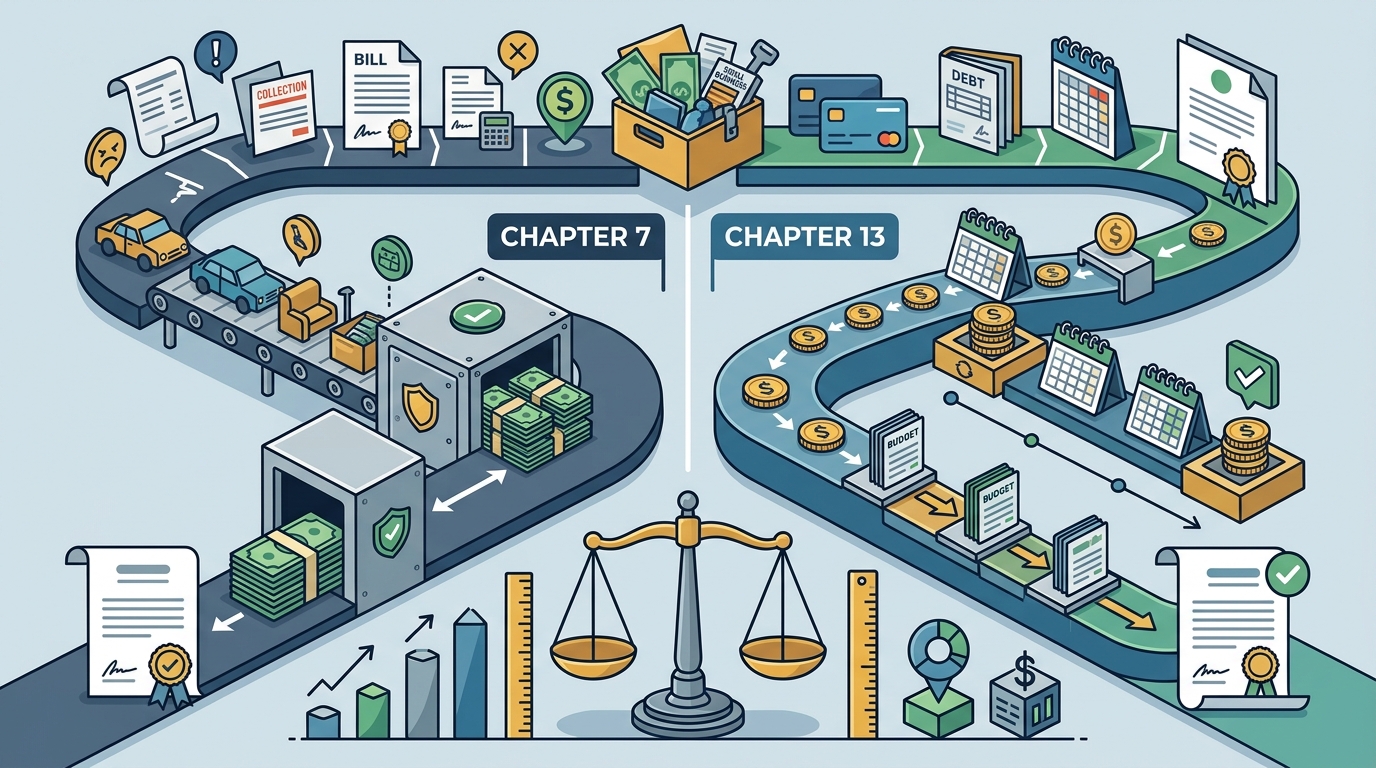
The timeline of your bankruptcy case is a major differentiator. Chapter 7 cases are typically concluded within three to six months. Once the meeting of creditors is held and the discharge is granted, your eligible debts are wiped clean. This includes credit card debt, medical bills, and personal loans. However, certain debts are non-dischargeable, such as student loans, recent tax obligations, and domestic support obligations.
Chapter 13 requires a court-approved repayment plan that lasts three to five years. During this time, you make monthly payments to a trustee, who then distributes the funds to your creditors. The amount you pay is based on your disposable income and the value of your non-exempt assets. At the end of the plan, any remaining eligible unsecured debt is discharged. This structure allows you to manage your debts over time, providing a predictable payment schedule that can help with budgeting.
According to data from the Federal Reserve's Summary of Economic Conditions, structured repayment plans are increasingly popular among consumers seeking financial stability. For a deeper dive into the mechanics of repayment plans, read the Investopedia overview of Chapter 13.
Credit Report Impact and Timeline
Both Chapter 7 and Chapter 13 bankruptcy have significant impacts on your credit score. A Chapter 7 filing remains on your credit report for ten years from the filing date. A Chapter 13 filing remains on your report for seven years from the filing date. While the duration differs, the initial impact is severe for both, often dropping your score by 200 points or more.
However, the path to credit recovery differs. With Chapter 7, you can begin rebuilding credit almost immediately after discharge. Many individuals see their scores improve within two years as they establish new lines of credit responsibly. With Chapter 13, you are required to maintain good credit behavior throughout the three to five-year plan. After completion, you may be able to rebuild credit faster than with Chapter 7 because the negative mark expires sooner.
Understanding the long-term credit implications is vital. For statistics on credit recovery post-bankruptcy, refer to the FICO blog on credit score recovery. You can also explore our blog resources for more tips on financial health.
Cost Comparison and Attorney Fees
The cost of filing for bankruptcy varies depending on the chapter and your attorney's fees. Chapter 7 generally has lower court filing fees and attorney costs because the process is simpler and faster. The current filing fee for Chapter 7 is $338. Attorney fees typically range from $1,000 to $2,500, depending on the complexity of your case.
Chapter 13 is more expensive due to the longer duration and the need for a repayment plan. The filing fee is $313. However, attorney fees are often paid through the repayment plan over three to five years. Total attorney fees for Chapter 13 can range from $3,000 to $5,000 or more. While the upfront cost is higher, the ability to save your home and pay off debts over time may make it a more viable option for some debtors.
For a detailed breakdown of costs, check the U.S. Courts filing fee schedule. To discuss your specific fee structure, contact PM Bankruptcy for a consultation.
Key Takeaways
- Chapter 7 is for liquidation: It wipes out unsecured debts quickly, typically within 3-6 months, but requires passing a means test.
- Chapter 13 is for reorganization: It involves a 3-5 year repayment plan, allowing you to keep assets like your home while catching up on arrears.
- Income limits matter: Chapter 13 requires a regular income and has strict debt caps, while Chapter 7 is income-sensitive via the means test.
- Asset protection differs: Chapter 7 relies on exemptions to protect property, while Chapter 13 protects all assets if payments are made.
- Credit impact duration: Chapter 7 stays on your report for 10 years, while Chapter 13 stays for 7 years from the filing date.
- Cost variance: Chapter 7 is generally cheaper upfront, while Chapter 13 fees are spread over the life of the plan.
- Debt discharge: Both chapters discharge eligible unsecured debts, but Chapter 13 may require partial repayment based on disposable income.
Frequently Asked Questions
Can I keep my house in Chapter 7?
You can keep your house in Chapter 7 if you are current on your mortgage and the equity in your home falls within your state's homestead exemption limits. If you are behind on payments, Chapter 7 may not stop foreclosure permanently.
What is the main advantage of Chapter 13?
The main advantage of Chapter 13 is the ability to stop foreclosure and catch up on missed mortgage payments over time while keeping your home. It also allows you to pay priority debts, like taxes, over the life of the plan.
How long does Chapter 7 bankruptcy last?
A Chapter 7 bankruptcy case typically lasts between three to six months from the filing date to the discharge of debts.
Can I file for bankruptcy twice?
Yes, but there are waiting periods. You must wait eight years from the date of a previous Chapter 7 discharge to file another Chapter 7. You must wait four years from a Chapter 7 discharge to file a Chapter 13.
Does bankruptcy erase all debts?
No. Certain debts are non-dischargeable, including student loans, recent tax debts, child support, alimony, and debts incurred through fraud or willful injury.
How does bankruptcy affect my credit score?
Bankruptcy significantly lowers your credit score initially. However, many individuals see their scores improve within two years as they establish new credit responsibly.
Do I need an attorney for Chapter 13?
While not legally required, Chapter 13 is complex and requires a detailed repayment plan. An attorney is highly recommended to ensure compliance with court rules and maximize your chances of success.
Take Control of Your Financial Future
Deciding between Chapter 7 and Chapter 13 is not a one-size-fits-all decision. It requires a careful analysis of your income, assets, and debt structure. At PM Bankruptcy, we provide the expert guidance you need to navigate this complex legal landscape. We help you understand your options, protect your assets, and build a path to financial freedom. Do not wait until it is too late to seek help. Contact PM Bankruptcy today to schedule your consultation and start your journey toward a fresh start.