

Chapter 7 bankruptcy, often referred to as "liquidation" bankruptcy, remains the most common form of personal debt relief in the United States. According to recent judicial statistics, Chapter 7 filings account for approximately 40% of all consumer bankruptcy cases annually. This legal pathway offers a fresh start by discharging most unsecured debts, such as credit card balances and medical bills, within three to six months. However, navigating the federal bankruptcy code requires precise adherence to eligibility thresholds and procedural deadlines. Understanding the mechanics of the means test and the role of the trustee is critical for protecting your assets while achieving financial freedom.
Eligibility Requirements and the Means Test
Before filing for Chapter 7, you must pass the "means test." This calculation determines whether your income is low enough to qualify for liquidation bankruptcy or if you are required to file under Chapter 13. The means test compares your median family income to the median income in your state for a household of your size.
Chapter 7 is a legal process designed to eliminate unsecured debt. If your income falls below the state median, you automatically qualify. If it exceeds the median, the test deducts allowable expenses to see if you have disposable income. If the calculation shows you cannot repay a significant portion of your debts, you remain eligible for Chapter 7. This framework ensures that bankruptcy relief is targeted toward those who genuinely cannot afford to repay their obligations.
For a detailed breakdown of how the means test is calculated, you can review the official Justice Department guidelines on bankruptcy procedures. Additionally, understanding your local exemption laws is crucial, which we discuss in the next section.
Asset Protection and Exemptions
A common fear surrounding Chapter 7 is the loss of all personal property. In reality, most filers retain their home, car, and personal belongings due to exemption laws. Exemptions are legal provisions that allow you to keep a certain amount of equity in specific assets. These laws vary significantly by state, with some states allowing you to choose between federal and state exemptions, while others mandate one or the other.
Homestead exemptions protect the equity in your primary residence. If your home equity is below the exemption limit, the trustee will not sell your home. Similarly, vehicle exemptions protect a certain value in your car. For instance, many states allow you to exempt up to $10,000 or more in vehicle equity. If your car's value exceeds this limit, you may need to negotiate a repayment plan with the trustee or convert to Chapter 13.
To understand how your specific state handles asset protection, consult the comprehensive Nolo guide on bankruptcy exemptions. At PM Bankruptcy, we specialize in analyzing your unique asset portfolio to maximize these protections during your filing.
The 341 Meeting of Creditors
Approximately 20 to 40 days after filing your petition, you will attend the "341 Meeting of Creditors." Despite its intimidating name, this meeting is rarely attended by actual creditors. Instead, it is presided over by the court-appointed bankruptcy trustee, whose job is to verify the accuracy of your paperwork and ensure you are not hiding assets.
You must bring specific documents to this meeting, including a government-issued photo ID, proof of Social Security number, and recent pay stubs. The trustee will ask you to swear under oath that the information in your petition is true. It is vital to be honest and consistent in your answers. Any discrepancies can lead to the dismissal of your case or, in severe cases, criminal charges for bankruptcy fraud.
For more information on what to expect during this procedural step, refer to the Consumer Financial Protection Bureau's explanation of the 341 meeting. Our team at PM Bankruptcy prepares you thoroughly for this meeting to ensure a smooth process.
Dischargeable vs. Non-Dischargeable Debts
Not all debts are eligible for discharge in Chapter 7. Understanding which debts will be wiped clean and which will remain is essential for setting realistic expectations. Chapter 7 is particularly effective for eliminating unsecured debts that have no collateral.
Dischargeable debts typically include credit card balances, medical bills, personal loans, and utility bills. These are the debts that often cause the most financial stress and are the primary targets for Chapter 7 relief. However, certain obligations survive the bankruptcy process. These non-dischargeable debts include student loans, child support, alimony, most tax debts, and fines owed to government agencies.
If you are concerned about specific debts, such as recent tax filings or student loan hardship, you should consult with a legal expert. The Cornell Law School's legal encyclopedia provides a detailed list of dischargeable and non-dischargeable obligations. We can help you evaluate your specific debt mix at PM Bankruptcy to determine the best course of action.
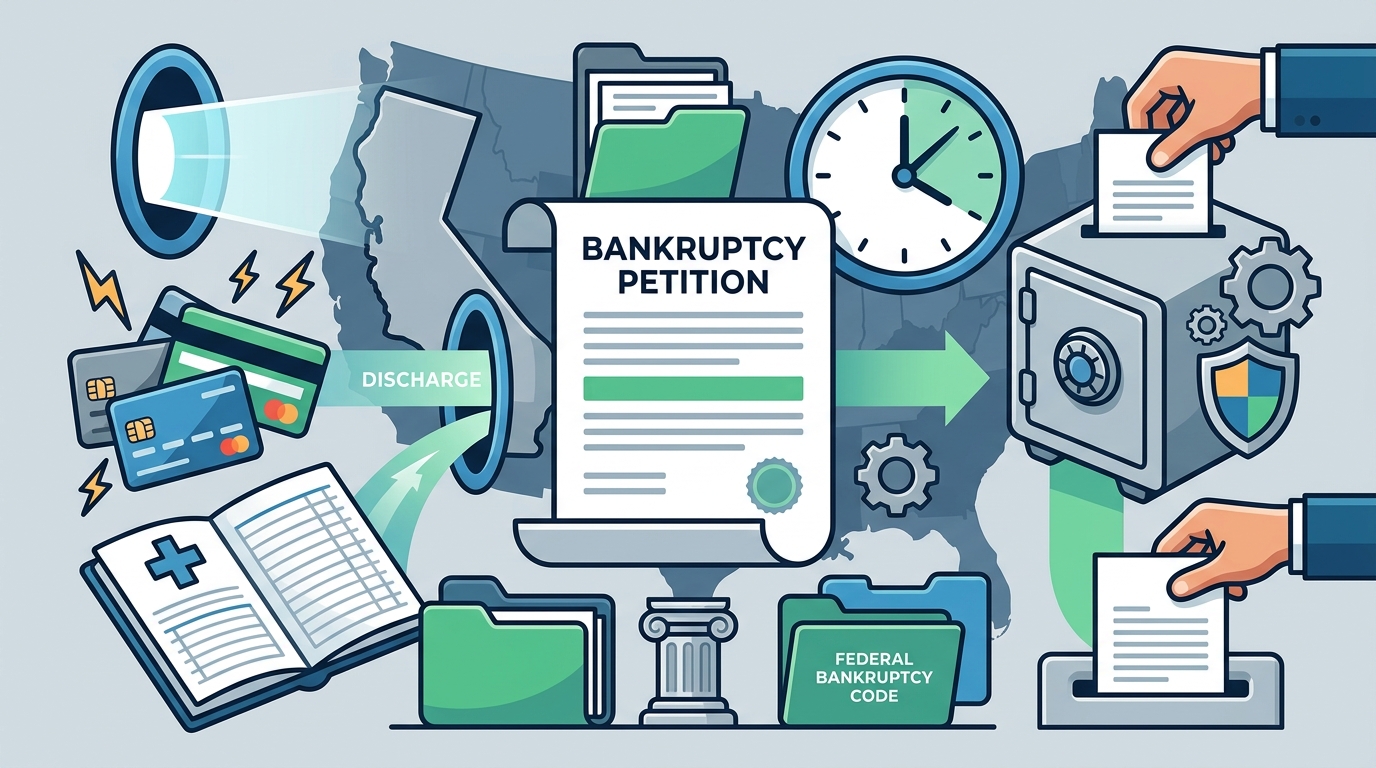
Chapter 7 vs. Chapter 13 Bankruptcy
Choosing between Chapter 7 and Chapter 13 depends on your income, asset equity, and long-term financial goals. Chapter 7 is a liquidation process that wipes out debt quickly, while Chapter 13 is a reorganization plan that requires a three-to-five-year repayment schedule.
| Feature | Chapter 7 | Chapter 13 |
|---|---|---|
| Duration | 3-6 months | 3-5 years |
| Income Requirement | Must pass means test | Must have regular income |
| Asset Retention | Protected by exemptions | Protects equity above exemptions |
| Debt Discharge | Most unsecured debts | Remaining unsecured debts after plan |
| Foreclosure Prevention | No | Yes, if caught in time |
If you are behind on mortgage payments and want to keep your home, Chapter 13 might be the better option. However, if you have no significant equity in your assets and meet the income requirements, Chapter 7 offers the fastest path to debt freedom. For a personalized comparison of your options, visit our bankruptcy comparison page.
Key Takeaways
- Chapter 7 bankruptcy typically discharges unsecured debts within 90 to 120 days of filing.
- The means test is the primary gatekeeper for eligibility, based on your median income versus state averages.
- Exemption laws vary by state and are critical for protecting your home and vehicle from liquidation.
- The 341 meeting is a mandatory procedural step where the trustee verifies your petition accuracy.
- Student loans, child support, and recent tax debts are generally non-dischargeable in Chapter 7.
- Chapter 13 is an alternative for those with higher income or significant home equity they wish to protect.
- Consulting with a local bankruptcy attorney ensures your exemptions are maximized and your filing is error-free.
Frequently Asked Questions
How long does Chapter 7 bankruptcy take?
The entire process typically takes between three to six months from the date of filing to the discharge of debts. The speed depends on court schedules and the complexity of your case.
Will I lose my house in Chapter 7?
You will only lose your house if your equity exceeds your state's homestead exemption limit. If your equity is within the exemption limit, you can keep your home.
Can I file for Chapter 7 if I have a car payment?
Yes, you can file for Chapter 7 even if you have car payments. You can choose to reaffirm the debt to keep the car or surrender the vehicle to the lender.
What is the means test?
The means test is a mathematical calculation used to determine if your income is low enough to qualify for Chapter 7 bankruptcy or if you must file under Chapter 13.
Does Chapter 7 affect my credit score?
Yes, a Chapter 7 bankruptcy will remain on your credit report for up to 10 years. However, many filers see their credit scores improve shortly after discharge because the negative debts are removed.
Can I file for bankruptcy again?
You must wait eight years from the date of your previous Chapter 7 filing before you can file another Chapter 7 case. You can file a Chapter 13 case two years after a Chapter 7 filing.
What debts are not discharged in Chapter 7?
Non-dischargeable debts include student loans, child support, alimony, most tax debts, and debts incurred through fraud or willful injury.
Start Your Fresh Start Today
Debt does not define your future. Chapter 7 bankruptcy offers a legal mechanism to eliminate overwhelming unsecured debt and allow you to rebuild your financial life. The process is complex, but with the right guidance, it is manageable. At PM Bankruptcy, we provide expert legal counsel tailored to your unique financial situation. Schedule your free consultation today to explore your options and take the first step toward financial freedom.